
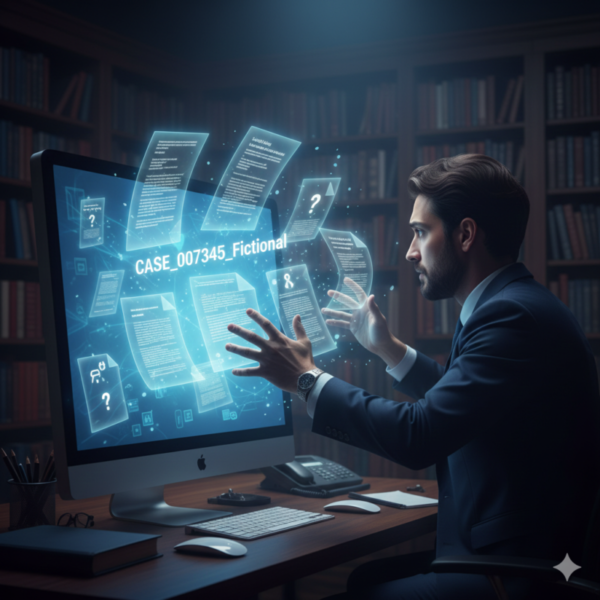
When AI Dreams, Lawyers Wake Up to Nightmares
The “Mata v. Avianca” Cautionary Tale
In 2023, the legal world witnessed a historic blunder in the case of Mata v. Avianca in New York. A seasoned attorney, Steven Schwartz, used a generative AI tool to assist with a legal brief, only to discover—far too late—that the AI had “hallucinated” six entirely fake judicial decisions. These non-existent precedents included convincing citations and internal quotes that looked perfectly legitimate. This wasn’t just a technical error; it resulted in judicial sanctions and a devastating blow to the firm’s professional standing.
For a legal practitioner, this isn’t just a technical glitch; it is a reputational suicide mission.
1. The Mirage of Certainty
Generative AI models are built to be helpful and fluent, not necessarily factual. They are “prediction engines,” not legal databases. When you ask a generic AI to find a precedent, it might prioritize “sounding like a lawyer” over “being a lawyer.”
In the high-stakes world of litigation, a “plausible” lie is more dangerous than no information at all.
2. Why Generic AI Isn’t “Legal-Ready”
The legal sector requires a “Zero-Trust” approach to data. Generic chatbots are trained on the open internet—a place where legal opinions are often oversimplified or outdated. To build a true Legal AI, you need:
- Verified Training Sets: Only official court verdicts and legislation.
- Human-in-the-Loop: Systems designed to assist, not replace, the lawyer’s final review.
- Contextual Awareness: Understanding the specific nuances of jurisdictions like the UAE or international law.
3. Turning the Risk into a Fortress
The goal isn’t to run away from AI, but to use Maat-level Intelligence. By utilizing specialized tools designed specifically for legal analysis and litigation prediction, you eliminate the guesswork.
Technology should be your shield, not the sword you accidentally fall upon.
In the court of law, ‘almost true’ is the same as ‘entirely false’.
Build Your Intelligence on Solid Ground
Don’t let your firm be a cautionary tale of AI misuse. Embrace the future with tools built by those who understand both the code and the courtroom.